
Most property owners think of their land and buildings as firmly under their own control — until they aren’t. Government authority over private property runs deeper than many people realize, and it doesn’t always announce itself with a lawsuit or a formal notice. Zoning changes, easements, tax liens, and code enforcement actions can all reshape what you can do with property you legally own. Understanding the mechanisms behind these interventions — and the rights you retain — is essential for anyone who owns, inherits, or plans to purchase real estate in the United States.
Eminent Domain and the Taking of Private Property
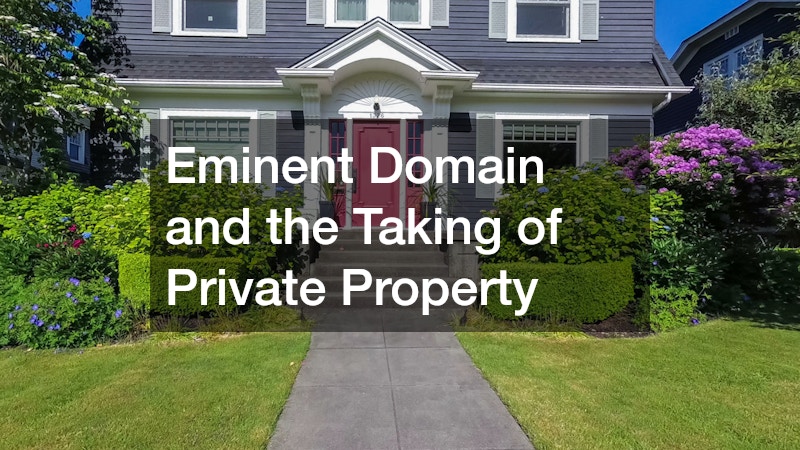
The most direct way government affects private property is through eminent domain — the constitutional authority to take private land for public use. The Fifth Amendment requires that owners receive just compensation when this happens, but what counts as “just” is frequently contested. Appraisals commissioned by government agencies don’t always reflect market value, and owners who accept the first offer without independent legal review often receive less than they’re entitled to.
The formal legal process through which eminent domain is exercised is condemnation, and it can apply to anything from a strip of land needed for a highway expansion to an entire parcel slated for a public utility corridor. What surprises many owners is how broadly courts have interpreted “public use.” A 2005 Supreme Court ruling in Kelo v. City of New London upheld taking private property for economic development purposes, expanding the potential scope well beyond roads and schools.
Practical steps if you receive an eminent domain notice:
- Hire an independent real estate appraiser within 30 days of receiving a government valuation, and compare their figure against the agency’s offer before signing anything.
- Request the full scope of the project in writing — a taking limited to 20 feet of frontage can still destroy the functional value of an entire lot.
- Consult an attorney who specializes in eminent domain before accepting any settlement; legal fees in these cases are often recoverable.
Zoning, Land Use Restrictions, and Regulatory Takings
Short of physically seizing property, government can dramatically limit what an owner does with it through zoning ordinances and land use regulations. A parcel zoned for residential use cannot typically house a warehouse. Land in a flood plain overlay district may require elevation standards that make construction prohibitively expensive. Historic preservation designations can restrict even minor exterior modifications.
These restrictions don’t trigger compensation the way eminent domain does — with one important exception. When a regulation goes so far that it eliminates essentially all economic value from a property, courts may recognize what’s called a regulatory taking. The standard comes from Lucas v. South Carolina Coastal Council (1992), where the Supreme Court found that a state environmental regulation that rendered beachfront lots worthless required compensation. The line between a permissible regulation and a compensable taking remains one of the most litigated areas of property law.
For owners weighing whether to challenge a restrictive zoning decision versus working within it, the decision often comes down to timeline and cost. Seeking a variance or rezoning through the local planning board takes months but costs relatively little. Litigation can take years and tens of thousands of dollars, with no guaranteed outcome. For most owners, the more practical path is to negotiate with planning authorities first — presenting traffic studies, environmental assessments, or comparable use approvals from nearby parcels — before committing to a legal fight.
Tax Liens, Code Enforcement, and Government Liens
Government also affects property through financial mechanisms that don’t involve any physical intervention at all. When property taxes go unpaid, the jurisdiction places a lien against the property. That lien accrues interest — often at rates between 12% and 18% annually depending on the state — and if left unresolved, can eventually lead to a tax sale where the government sells the property to recover the debt.
Code enforcement operates differently but carries comparable stakes. A structure found to be in violation of local building or health codes can be subject to fines, repair orders, or in extreme cases, demolition authority. Liens from unpaid code enforcement fines attach to the property itself, not just the owner, which means a buyer who purchases a property with unresolved violations inherits the liability.
This creates a meaningful difference between buying a property in good standing and purchasing one with a complicated compliance history:
- Order a municipal lien search at least 10 business days before closing on any property purchase — standard title searches don’t always capture code enforcement fines.
- In jurisdictions that offer tax lien certificates for public purchase, verify whether any certificates on the target property are still within the redemption window before assuming clean title.
- Request a written certificate of code compliance from the local building department before finalizing any transaction involving a property with permitted renovation history.
Easements, Rights-of-Way, and Environmental Restrictions
Government entities can also affect property through easements and rights-of-way that allow access or use without transferring ownership. Utility easements permit power companies or municipalities to run infrastructure across private land. Conservation easements — sometimes entered voluntarily in exchange for tax benefits, other times imposed through environmental regulation — can permanently restrict development on portions of a parcel.
Federal environmental designations add another layer. Wetlands on private property fall under jurisdiction of the Army Corps of Engineers and the EPA. Filling or developing a federally regulated wetland without a permit can result in fines exceeding $25,000 per day and mandatory restoration orders. Owners often discover wetland designations only after purchase, particularly on rural or semi-rural parcels where environmental surveys weren’t part of the original due diligence.
The calculus between accepting an easement voluntarily versus contesting one imposed through regulation usually hinges on the terms and duration. A permanent conservation easement may qualify for a charitable deduction worth 50% of the restricted value — a meaningful financial benefit for some owners. A utility right-of-way with no compensation offer, by contrast, warrants legal review before any access is granted.
Knowing Where You Stand Before a Dispute Arises
The owners most affected by government property actions tend to be those who didn’t know the risks existed. A title commitment reviewed before purchase, a municipal lien search before closing, and a survey that identifies existing easements all cost relatively little — typically between $300 and $800 combined — compared to the cost of resolving a dispute after the fact. When any government notice arrives, the response window matters: most administrative appeals have deadlines between 20 and 60 days, and missing them can waive rights that would otherwise be available. Treating property ownership as an ongoing legal relationship, not a one-time transaction, is what separates prepared owners from surprised ones.