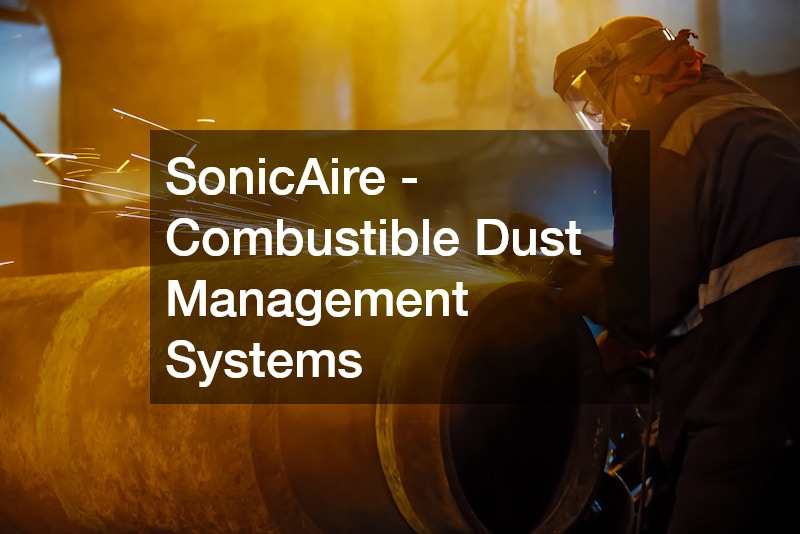
Even well-designed dust collection and filtration systems do not capture every airborne particle produced in industrial environments. In manufacturing, woodworking, food processing, metalworking, and other material-handling operations, fine particulate matter can escape primary collection points and remain suspended in the air or settle on elevated surfaces. Over time, this residual dust can accumulate in overlooked areas such as rafters, ceilings, duct exteriors, and equipment ledges.
This is where many facilities begin to understand a critical gap: traditional filtration is essential but not always complete. Addressing that gap requires a broader strategy that accounts for air movement, secondary capture, and ongoing dust control in areas beyond the immediate source.
Why Filtration Systems Miss Airborne Dust
Most industrial dust collection systems are designed to capture particles at or near the source of generation. Local exhaust ventilation, hoods, and ducted systems are highly effective when properly maintained and correctly positioned. However, they are not designed to control every particle that becomes airborne in the broader facility space. Several factors contribute to missed dust:
Airflow disruption is one of the most common causes. When machinery operates, doors open, forklifts move, or employees circulate through a facility, air currents shift unpredictably. These movements can push fine dust particles outside the capture zone of primary filtration systems.
Particle size also plays a role. Combustible dust can be extremely fine and lightweight, allowing it to remain suspended for extended periods. These particles often bypass capture points and travel into elevated or low-velocity air zones.
In addition, system limitations such as aging equipment, inadequate hood placement, or insufficient capture velocity can reduce efficiency. Even minor inefficiencies in a system can allow dust to accumulate over time in areas that are not routinely cleaned or monitored.
This is where the importance of combustible dust management systems becomes more apparent, as they account not only for point-of-source capture but also for facility-wide dust behavior and movement patterns.
The Hidden Risk of Residual Dust Accumulation
When dust escapes filtration systems, it does not simply disappear. It settles on surfaces throughout the facility, including structural beams, overhead piping, electrical panels, and storage racks. While these deposits may seem harmless at first, they can accumulate into layers that increase risk over time.
Combustible dust, when dispersed in sufficient concentration and under the right conditions, can ignite rapidly. Even thin layers can become hazardous if disturbed and suspended in the air. This makes routine housekeeping and supplemental dust control essential components of a complete safety strategy.
Beyond safety concerns, residual dust can also impact equipment performance. Dust buildup on motors, sensors, and ventilation components can reduce efficiency and increase maintenance requirements. In some environments, it may also contribute to product contamination or quality control issues.
Addressing the Gaps Left by Primary Filtration
Because primary filtration systems are not designed to control ambient dust throughout a facility, many operations implement secondary control strategies. These approaches focus on managing airborne particles that escape initial capture and preventing long-term accumulation.
One common method is improving overall air circulation patterns within the facility. By influencing how air moves through open spaces, it becomes possible to reduce stagnant zones where dust tends to settle. This is especially important in large-volume industrial buildings where ceiling height and open floor plans create uneven airflow distribution.
Another strategy involves routine industrial cleaning programs, including vacuum systems designed for fine particulate removal. While effective, these methods are often reactive rather than continuous, meaning dust must first accumulate before it is removed.
For this reason, many facilities are shifting toward continuous mitigation approaches that operate alongside filtration systems rather than replacing them.
The Role of Facility-Wide Air Movement Control
A growing focus in industrial environments is the use of engineered air movement to help control dust behavior beyond point-of-source capture. Instead of relying solely on ducted systems, these solutions work by continuously influencing how air—and the dust within it—moves throughout a facility.
By reducing stagnant air pockets and minimizing dust settlement on elevated surfaces, facility-wide air movement systems can complement traditional filtration. This creates a more balanced approach where airborne particles are less likely to remain suspended long enough to settle in hazardous areas.
When integrated properly, these systems can support combustible dust management systems by addressing the portion of airborne particulate that escapes initial capture. This layered approach helps reduce accumulation over time and supports a cleaner operational environment.
Integrating Filtration, Housekeeping, and Airflow Strategies
No single system is capable of managing all aspects of dust control in an industrial setting. Effective dust mitigation typically involves a combination of technologies and practices working together. Filtration systems remain the first line of defense, capturing dust at its source. Regular maintenance ensures they operate at peak efficiency and continue to meet design specifications. However, without complementary strategies, even high-performing systems will leave behind residual particulate.
Housekeeping programs provide another essential layer. Routine cleaning schedules help remove settled dust before it can build into hazardous layers. In high-risk environments, this may include specialized vacuum systems designed for combustible materials.
Finally, facility-wide airflow management helps address the continuous movement and redistribution of airborne dust. When combined, these three elements create a more comprehensive approach to dust control that reduces risk and improves overall operational conditions.
Moving Toward a More Complete Dust Control Strategy
Facilities that rely solely on filtration often underestimate how much dust remains uncollected in the broader environment. While primary systems are essential, they are only one part of a larger control strategy. Addressing the dust that escapes requires attention to airflow behavior, surface accumulation, and long-term environmental conditions. Over time, organizations that adopt a more holistic approach often see improvements not only in safety but also in equipment longevity, housekeeping efficiency, and overall air quality.
Ultimately, effective dust control is not about relying on a single solution but about building a layered system that accounts for how dust behaves throughout an entire facility. SonicAire supports this approach by helping industrial operators address airborne dust beyond traditional filtration boundaries, reinforcing a more complete and proactive strategy for managing risk and maintaining cleaner production environments.